
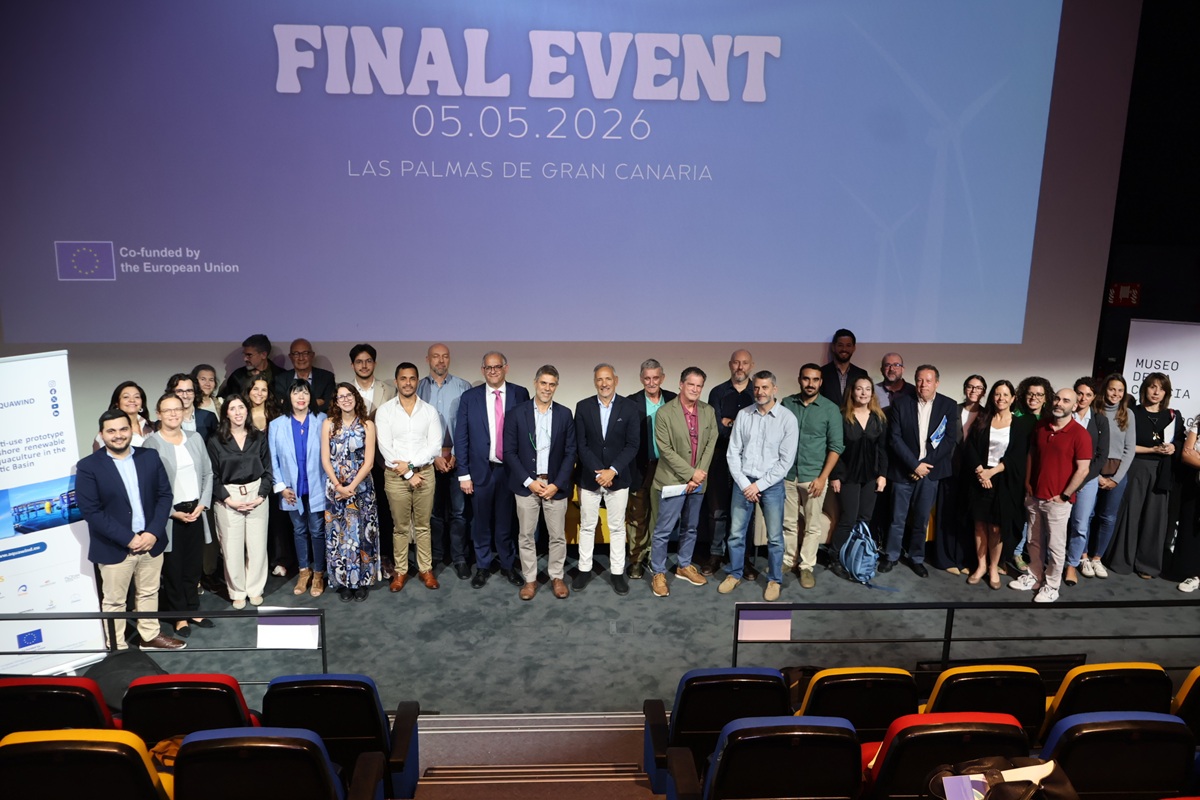
The European AquaWind project, coordinated from the Canary Islands and 80% funded by the European Union via the European Maritime, Fisheries and Aquaculture Fund (EMFAF), held its final event on 5 May 2026 at the Elder Museum of Science and Technology in Las Palmas de Gran Canaria, Spain. After 45 months, the initiative has demonstrated in real open-sea conditions the feasibility of integrating floating offshore wind with offshore aquaculture on a single platform.
Real Prototype in Atlantic
The project’s key achievement was installing and testing a prototype at PLOCAN’s test site, combining EnerOcean’s W2Power dual-turbine floating wind platform with an automated aquaculture pen featuring advanced monitoring. Trials involved gilthead sea bream juveniles to study behaviour, alongside structural resilience and marine interactions under extreme conditions, including storms with waves up to 6.5m. Speakers emphasised the shift from simulations to a functioning Atlantic prototype, with designs also exploring high-value species like greater amberjack (Seriola dumerili).
Environmental and Social Insights
AquaWind advanced understanding of environmental impacts and social acceptance, showing multi-use platforms can optimise space, ease marine pressures and foster sector synergies. Stakeholder engagement gathered over 120 inputs from Canary Islands actors via surveys and interviews, revealing positive perceptions as an economic opportunity rather than a conflict. Fish from offshore trials showed higher protein and lower fat content due to dynamism, with copper nets reducing biofouling compared to nylon.
Regulatory Hurdles
Despite successes, panellists highlighted regulatory and administrative bottlenecks as the main barriers to scale-up, with fragmented permitting processes lacking clear multi-use frameworks. Unforeseen challenges included boat access licences and coordination across institutions, exacerbated by storms delaying operations. Recommendations urge streamlined “one-stop-shop” approvals, harmonised environmental assessments and early dialogue to prevent innovation stalling at demonstration.
Event Highlights
The gathering featured institutional openings by Canary Agency for Research, Innovation and Information Society director Javier Franco, DG MARE and CINEA representatives, affirming Europe’s blue economy priorities. Technical presentations and roundtables covered impacts and regulations, with virtual reality demos of the prototype. Franco positioned the Canary Islands as a blue economy innovation hub, while EU speakers noted AquaWind’s Atlantic Project Award 2025 win.
Path Forward
AquaWind leaves validated technical, environmental and economic data, plus a collaborative model for future growth. The consortium calls for pre-commercial advances amid Europe’s push for marine renewables and food security, stressing that overcoming regulatory inertia will determine real economic benefits.